Whitepapers · 01
Why can't two SKUs with identical geometry, differing only in black vs. white, share one mold?
WP-01 · Why Black and White Zirconia Can't Share a MoldI · Real Case & Mechanism
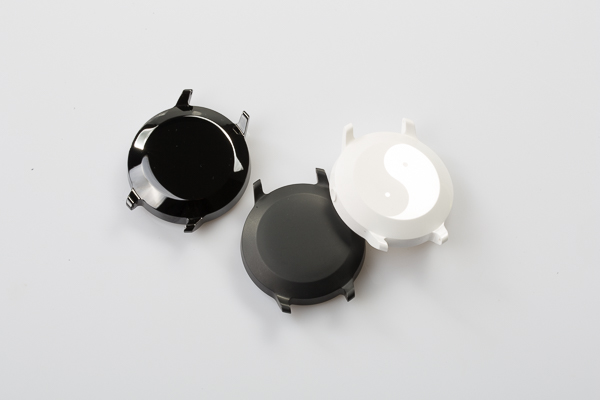
Failure Scenario
Black and white SKUs shared a mold. Black samples came out 0.8%oversize on the mating dimension; white was fine. Retuning the mold undersized white instead. The two colors could never pass together.SUPPORTING FACT: at equal geometric volume, the black version weighs about 8-10% more than white. If the product has a weight spec, both color versions need separate callouts.
Mechanism: black zirconia's colorant mechanism changes the powder's sintering behavior, producing a systematic difference in linear shrinkage versus white - a systematic bias, not random noise. A mold designed against one shrinkage rate will always leave the other color systematically off, and the direction and magnitude of that deviation stay consistent across multiple batches - this isn't process instability producing random error.
II · The Real Consequence of Sharing a Mold
If black passes, white goes out of tolerance - the two color versions can't both satisfy their tolerance requirements at once. This can't be fixed by mold rework, because the two colors' target shrinkage rates are simply different - retuning can only bring one color closer to passing, never both at the same time.
III · The Correct Approach
Tool each color independently against its own shrinkage rate - both can achieve ±0.05mm. This is already published on the DFM 02-B page; this paper is the mechanism backing that rule.
IV · Design Rules
- For dual-color products, don't assume a shared mold will save cost - this is a physical constraint, not a supplier's commercial strategy
- If a product must ship in both black and white, submit both mold-development plans separately at the DFM stage, rather than tooling one color and trying to stretch it to fit the other
- Weight-sensitive applications need separate weight specs for black and white - they can't share one number
PROJECT CTA
Does this apply to your project? If your design is running into a similar issue, send us your design files or describe your application — we'll give you a clear judgment within 3 business days.